
- Perth has some of the harshest UV in the country, with a UV index of 11 to 12 through summer, so exterior paint breaks down faster here than in milder climates.
- Surface temperature matters more than air temperature. Paint walls when they are in shade, not in direct sun.
- Spring and autumn are usually the best seasons for exterior painting in Perth.
- Preparation and a quality exterior acrylic system decide how long the job lasts. Two full coats are standard.
Exterior painting in Perth is a different job from painting a house in Melbourne or Hobart. Our sun is stronger, our summers are longer and the west side of a house can bake for hours every afternoon. The result is paint that chalks, fades and cracks sooner than you would expect. The good news is that most early failures come down to three things you can control: the paint system, the timing and the preparation.
This guide explains how Perth’s climate affects exterior paint, which products hold up best, when to book the job, and what good preparation looks like.
Table of Contents
Why Perth is so hard on exterior paint
Perth averages around 8.8 hours of sunshine a day, and the Bureau of Meteorology records a mean UV index of about 12 in December and January and 11 in February, which sits in the extreme band. That ultraviolet energy breaks down the binders that hold paint together. Once the binder weakens, pigment particles are released as a powdery chalk on the surface and colour starts to shift.
Heat adds another layer of stress. Summer maximums average above 31°C, and Perth sees around five days above 40°C a year. Dark walls get much hotter than the air around them, so the paint film expands and contracts every day. Older or poorly bonded coats eventually crack and lift.
Which walls fail first
Paint maker Wattyl notes that west and north-facing elevations commonly cop the highest UV exposure. In Perth that matches what painters see: the western wall that faces the afternoon sun almost always fades first, followed by the northern side.
| Elevation | Sun exposure in Perth | What to expect |
|---|---|---|
| West | Intense afternoon sun and heat | Fastest fading and chalking; inspect yearly |
| North | Sun most of the day, especially in winter | Steady fading; often second to fail |
| East | Morning sun only | Moderate wear |
| South | Mostly shaded | Slowest fading, but watch for mould |
Which paints last longest in Perth sun
For most homes, the longest-lasting option for exterior painting is a premium 100% acrylic exterior system from a recognised brand, applied over the correct primer. Acrylics stay flexible as walls heat and cool, they breathe so moisture can escape, and the better products are formulated to resist UV degradation.
- Premium exterior acrylic: the standard choice for render, brick, fibre cement and timber. Look for products sold for high-UV Australian conditions.
- Heat-reflective coatings: some ranges reduce the heat absorbed by darker colours. These can help on west walls and roofs.
- Specialist systems: metal, Colorbond, bare timber and previously oil-painted surfaces need their own primers. Ask before you buy.
Price is a rough guide to quality. Cheaper paints usually contain less binder and pigment, which is exactly what UV attacks. Over a repaint cycle, the better product nearly always costs less.
Does colour make a difference?
Yes. Darker colours absorb more heat, so the surface runs hotter and the paint works harder. Very dark tones can also show fading sooner. Lighter and mid-tone colours stay cooler and hide fine dust better, which matters on walls exposed to street dust or coastal haze. If you love a dark scheme, ask about heat-reflective versions of your chosen colour.
When to paint: the best months in Perth
The best time for exterior painting in Perth is usually spring (September to November) and autumn (March to May). Temperatures are moderate, rain is less frequent than in winter, and walls are not as hot as they get in January and February. Around 78% of Perth’s annual rain falls between May and September, so winter brings more delays and slower drying.
Painting in summer
Summer painting is possible, but timing each wall becomes critical. Wattyl’s guidance is clear: what matters is the temperature of the surface you are coating, not the air temperature, and you should avoid painting in direct sun on the working surface. A wall in full sun can be far hotter than the air, which makes paint dry too fast and leaves lap marks and weak adhesion.
- Start on the walls that are in shade first thing, then follow the shade around the house during the day.
- Begin mid-morning once any dew has dried.
- Stop early enough for the coat to set before evening humidity and dew arrive.
- Avoid very windy days, which carry dust and dry the paint too quickly.
Preparation that stops early fading
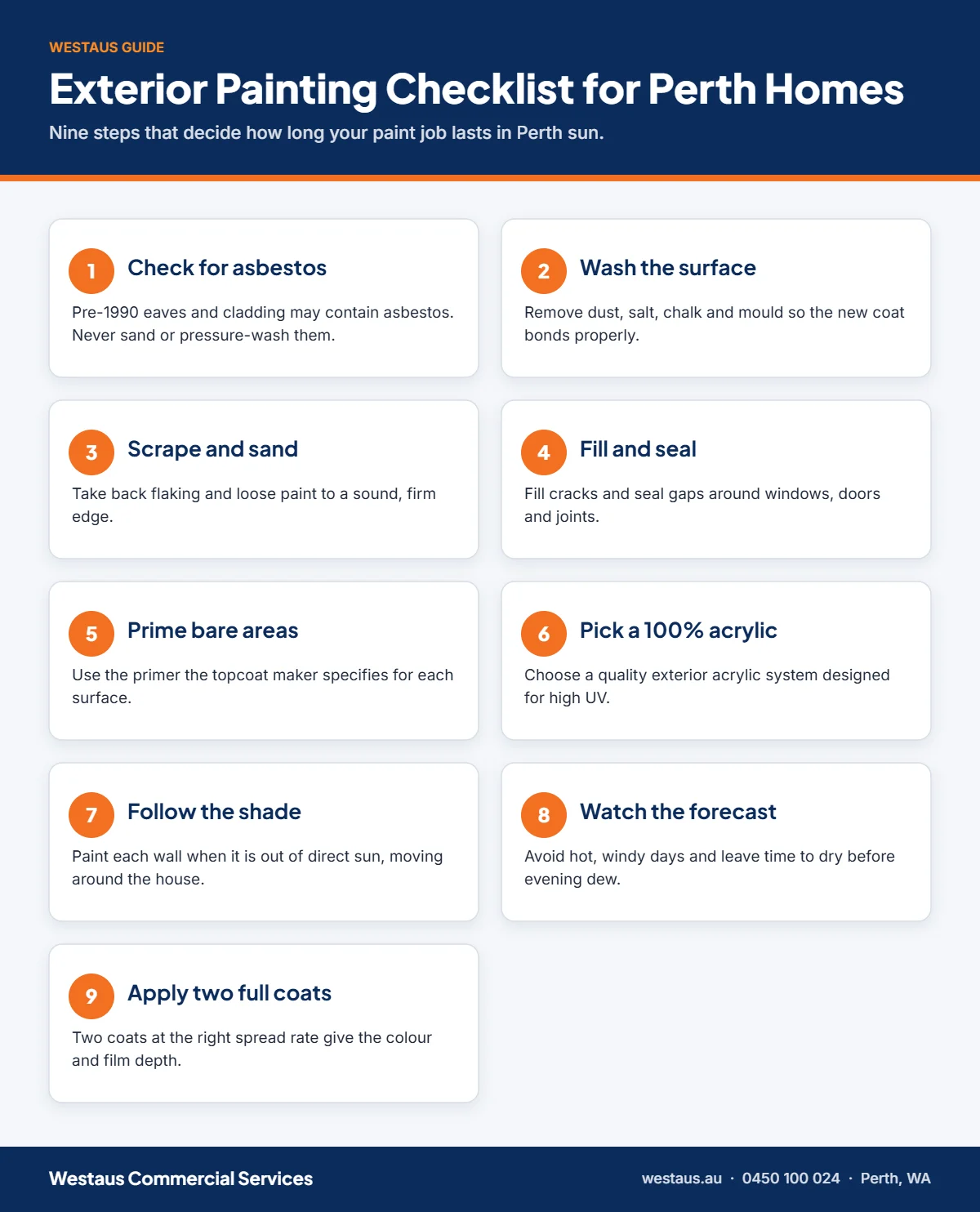
Most exterior paint failures are preparation failures. A premium paint over a chalky, dusty or flaking surface will not last. The infographic below shows the checklist we follow.
Check for asbestos before you start
Many Perth homes built before 1990 have asbestos cement eaves, cladding or fences. WA Health warns against using high-pressure water or abrasive methods on these products because they can release fibres. Do not sand, scrape aggressively or pressure-wash suspect sheeting. If you are unsure, have it tested before any exterior painting begins.
Clean, repair and prime
Wash walls to remove dust, salt and chalk. Treat mould on shaded walls. Scrape and sand loose paint back to a sound edge, fill cracks and seal gaps around frames. Any cracked render or damaged surfaces should be repaired first; our plastering services cover patching and render repairs. Prime bare timber, metal and new render with the primer the topcoat maker specifies.
How long does exterior paint last in Perth?
There is no single answer, because it depends on the product, colour, preparation and exposure. What we can say is that the west and north walls will need attention first, and that a well-prepared premium system lasts noticeably longer than a budget job. Check the manufacturer’s warranty terms, which usually depend on correct preparation and application.
A simple yearly routine helps you catch problems early:
- Rub a hand across the west wall. A heavy chalky residue means the coating is breaking down.
- Look for cracking, blistering or peeling around windows, eaves and fascia.
- Wash walls gently to remove dust and salt build-up, especially near the coast.
- Touch up small damaged areas before moisture gets behind the paint.
DIY or professional exterior painting?
Small jobs such as a fence, a garden wall or a single-storey feature wall can be good DIY projects if you prepare properly and paint in the shade. Two-storey homes, rendered walls with cracking, eaves that may contain asbestos and jobs that need scaffolding are better handled by professionals. A good painter will also tell you when a wall needs repair before paint, such as cracked render or a roof leak staining the eaves.
If you are preparing to sell, the right exterior painting can lift street appeal quickly. And if water stains are showing on eaves or ceilings, check the roof and gutters before painting over them; our roofing team can help find the source.
What affects the cost of exterior painting in Perth
Every exterior painting quote is built from the same handful of factors. Knowing them helps you compare quotes fairly and spot one that has left something out.
- Size and height. Two-storey walls need scaffolding or elevated work platforms, which adds cost and time.
- Surface condition. Chalky, cracked or flaking walls take longer to prepare than sound, recently painted ones.
- Number of surfaces. Walls, eaves, fascia, gutters, window frames, doors and fences are often priced separately.
- Colour change. Going from dark to light, or light to dark, can need an extra coat for even coverage.
- Access. Tight side setbacks, steep blocks, gardens and pools all slow the work.
- Paint system. Premium exterior acrylics and specialist primers cost more per litre but usually last longer.
A detailed quote should list the surfaces included, the preparation steps, the products and the number of coats. If two quotes for the same exterior painting job are far apart, the difference is usually in preparation or product.
Common exterior painting mistakes to avoid
Most of the problems we are called to fix after a DIY or budget exterior painting job come down to a few repeat mistakes:
- Painting over chalk. New paint will not bond to a powdery surface. Wash it off and use a sealer if the maker recommends one.
- Painting in full sun. Hot walls flash-dry the paint, causing lap marks and poor adhesion.
- Skipping primer on bare areas. Bare timber, metal and new render need the right primer or the topcoat will fail early.
- Thinning the paint too much. Over-thinned paint leaves a thin film that UV breaks down quickly.
- Ignoring the cause of stains. Water marks on eaves usually point to a gutter or roof problem that needs fixing first.
- Only one coat. A single coat rarely gives the film depth needed for long-term UV protection in Perth.
Avoiding these mistakes is the simplest way to make exterior painting last longer. If a wall has cracks that keep returning, have the cause checked before you paint; movement cracks will open again through new paint.
Tip: Keep the product names, colours and batch numbers from your exterior painting job. They make touch-ups and future repaints much easier to match.
Frequently asked questions
What is the best month for exterior painting in Perth?
Spring and autumn are usually best. In particular, September to November and March to May tend to offer moderate temperatures and less rain than winter.
Can you paint outside in Perth summer?
Yes, but avoid painting any wall while it is in direct sun. Follow the shade around the house, start mid-morning and stop before evening dew.
Why is my exterior paint chalky?
Chalking happens when UV breaks down the paint binder and releases pigment as powder. It is common on west and north walls in Perth. The surface needs cleaning and repainting with a quality exterior acrylic.
Are dark exterior colours a bad idea in Perth?
Not necessarily, but dark colours absorb more heat and may fade sooner. Heat-reflective versions of dark colours can help reduce surface temperature.
Do I need to remove all the old paint?
No. Loose, flaking or failing paint must be removed back to a sound edge, but well-bonded paint can usually be cleaned, sanded and recoated.
Planning exterior painting in Perth?
Tell us about your home, the walls you want painted and any problem areas. We will recommend a paint system and give you a clear written scope.